
You're looking at two sofas. One is Rs. 80,000. The other is Rs. 1,60,000. The expensive one seems crazy. The cheap one seems smart. Here's what most people don't see.
Buying Guides
The True Cost of 'Cheap' Furniture
What to look for when buying furniture in Nepal
5 min read
What "Half the Price" Actually Means
When you walk into a furniture showroom in Kathmandu, that Rs. 80,000 sofa looks perfect. The finish is smooth. The cushions are plump. The salesperson shows you three color options.
What they don't show you is what's inside.
What's Actually Inside Cheap Furniture
The price difference isn't just about wood quality - it's about what you can't see.
Hidden Cheap Wood
Weak Construction
Poor Finish
Hidden cheap wood in upholstered furniture:
Many Nepali carpenters use the cheapest wood possible for sofa frames - the kind used in fruit crates. You'd never buy a dining table made from that wood, but when it's hidden inside a fabric sofa, you have no way to know. The fabric looks good. The cushions are comfortable. But the frame underneath is weak from day one.
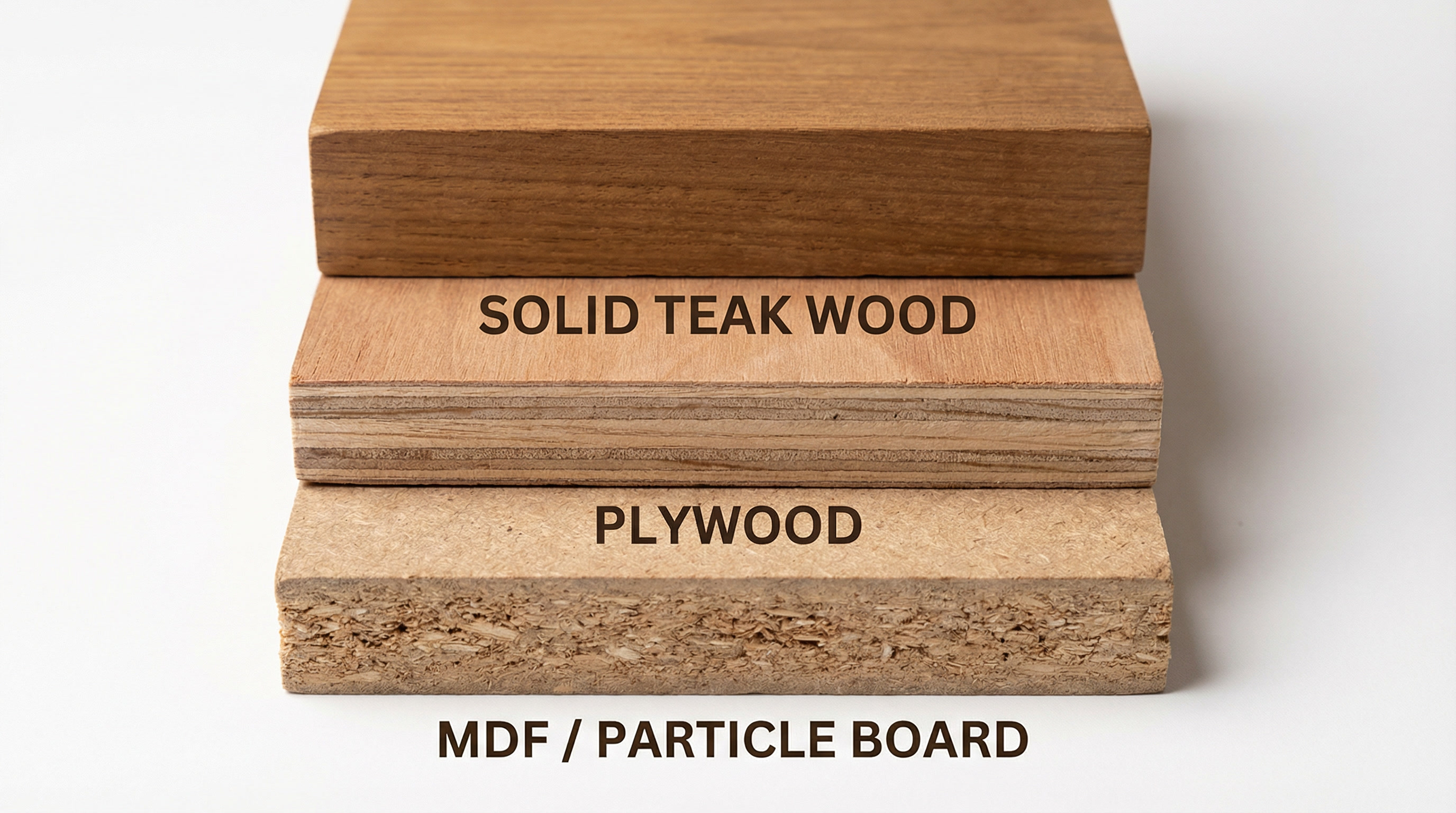
Compressed Wood Products (MDF and Particle Board)
You'll hear terms like "MDF" or see material that looks like thick, heavy board. This is wood fibers or wood chips compressed together with glue - engineers call it MDF (Medium Density Fiberboard) or Particle Board.
It's not bad material - it has legitimate uses in furniture. But in Nepal's climate, it behaves differently than solid wood:
In Monsoon
These compressed materials absorb moisture and swell.
In Winter
They dry out and can crack or delaminate.
Over Time
The structure weakens, especially at joints and screw points.
MDF is actually more durable than particle board. Quality furniture manufacturers use MDF for specific applications where it makes sense—cabinet backs, drawer bottoms, painted surfaces.
The problem is when entire furniture pieces are made from these materials and sold as if they're solid wood. That Rs. 80,000 sofa with a fabric cover? Unless you ask specifically, you won't know if the frame is solid wood or compressed board.
How to Tell the Difference
Ask to see unfinished parts
The inside of a drawer, the underside of a table, the back of a cabinet. Solid wood looks the same all the way through. Plywood shows layers when you look at the edge.
Weight tells the truth
Solid wood is heavy. Pick up a solid teak chair and you'll feel the weight. Plywood furniture feels lighter, almost hollow. If you can easily lift a dining table by yourself, that's your first clue.
The knock test
Knock on the furniture with your knuckles. Solid wood sounds dense and full. Plywood sounds hollow, almost like knocking on a door.
Construction Methods
Quality furniture uses mortise-and-tenon joinery—wood pieces fitted together like a puzzle, then glued. Cheap furniture uses screws and metal brackets. Nothing wrong with screws for certain applications, but when the entire structure depends on them, those joints loosen over time. That's why cheap sofas start wobbling after a year or two.
The Showroom vs. Your Home
Chinese and Hong Kong furniture often looks perfect in the showroom. Good finish, clean lines, attractive design. But here's what happens after you bring it home:
Screw joints loosen over time
Most imported furniture is held together with screws and metal brackets. After months of use - opening drawers, closing doors, moving the piece around - those screws work themselves loose.
Missing features Nepali families need
In Nepal, people use wardrobes like safes - storing jewelry, cash, important documents. But most imported wardrobes don't come with locks.
Designed for different climates
Furniture built for Hong Kong's climate doesn't account for Nepal's extreme monsoon-to-winter swings. The joinery that works fine in moderate humidity fails in Kathmandu.
You can't always tell by looking. You have to ask questions.
The Finish: Why It Matters More Than You Think
In Nepal, we have two extreme seasons that destroy cheap finishes: monsoon humidity and winter dryness.
Spray paint vs. professional PU finish:
Many affordable furniture pieces use spray paint or low-grade polish. It looks fine initially. But Nepal's climate is brutal on finishes. During monsoon, cheap finishes absorb moisture. The wood underneath swells. By winter, when the air dries out, the wood contracts. This constant expansion and contraction causes the finish to crack, peel, and flake.
Professional PU (polyurethane) finish is different. It's a sealed coating system—multiple layers that protect the wood from moisture. At Regalwood, we use SIMPRO 2K PU Clear Coat with hardener. It's the same finish system used on high-end European furniture.
The difference? PU-finished furniture doesn't need re-finishing. You dust it regularly, wipe it with filtered water (never tap water—Nepal's tap water leaves mineral marks), and it stays beautiful for decades.
How to ask about finish:
Don't accept "polish" as an answer. Ask: "What specific finish product do you use? What brand?" If they can't tell you, that's a red flag. Quality furniture makers know exactly what finish they're applying and can show you the product specs.
Questions to Ask ANY Furniture Maker (Including Me)
I genuinely don't care if you buy from Regalwood or someone else. I care that you know what you're buying. Here's what to ask:
1. Is this solid wood or plywood?
Ask to see unfinished parts. Don't take "wood" as an answer—that could mean anything.
2. What wood species?
In Nepal, many people think sisau (शीशम) is premium wood. Actually, teak (or sagwan—same wood, Nepali name) significantly outlasts sisau. Teak can last generations with proper care, while sisau is more prone to cracking—especially in Nepal's extreme monsoon-to-winter climate swings.
Read our detailed wood guide →3. What finish system do you use?
Get brand names. "Polish" tells you nothing. SIMPRO, JagMag, AkzoNobel—these are actual finish brands used in Nepal.
4. What's your warranty and what does it cover?
At Regalwood, we offer 10 years on construction. That's because we know our joinery won't fail. If someone offers 1 year or "no warranty," ask yourself why they're not confident in their work.
5. Can I see examples of 5+ year old pieces?
This is the question that separates serious furniture makers from everyone else. We keep samples. We can show you teak from 2019 that still looks perfect. Can they?
6. How are joints constructed?
Mortise-and-tenon? Dowels? Screws? This matters more than you think. Screwed joints loosen. Proper joinery lasts generations.
When "Cheap" Makes Sense
I'm not here to tell you that expensive furniture is always the right choice. Sometimes cheap makes perfect sense:
You're renting and will move in 2 years
Why invest in heirloom furniture if you're not settled? Get something functional and affordable.
It's temporary furniture for a space you're still figuring out
Maybe you just moved to Kathmandu and don't know your style yet. Buy cheap, live with it, figure out what you actually want, then invest.
You genuinely can't afford quality right now
No shame in this. We all start somewhere. Buy what you can afford, save up, upgrade when you're ready.
The key is knowing you're buying temporary furniture. Don't expect it to last 10 years. Don't be surprised when it wobbles after 3 years.
When You Should Invest
Here's when the Rs. 1,60,000 sofa makes sense:
You own your home
You're not moving. This furniture will be part of your daily life for the next 15-20 years.
You're tired of replacing furniture
You bought the cheap sofa 5 years ago. It's sagging. The cushions are flat. You're ready to buy once and be done.
You value craftsmanship
You want to support Nepali artisans. You appreciate the hours of handwork that go into each piece.
You want furniture your children will inherit
Not as an antique—as something they'll actually use. Furniture for the gatherings, the conversations, the everyday.
The Bottom Line
I run Regalwood, so yes, I make expensive furniture. But I didn't write this article to convince you to buy from me.
I wrote it because I'm tired of seeing people make decisions based on price alone, then regretting it 3 years later when their dining table is falling apart.
If you're confused about any furniture purchase in Nepal—mine or anyone else's—send me a message on WhatsApp. I'll help you figure out what to look for. No pressure. No sales pitch. Just someone who knows furniture helping someone who wants to make a smart decision.
Because at the end of the day, furniture is one of the few things you interact with every single day. Your sofa. Your bed. Your dining table. These are the places where life happens.
They deserve more than a quick decision based on the lowest price.
Frequently Asked Questions

Have questions about buying furniture in Nepal?
Whether you're buying from us or just want honest advice, we're here to help.
Start a Conversation